Most Commonly Used Alloy in the Aerospace Industry: Why Aluminum 7075 Still Dominates Aircraft Structures?
By Mufaddal Shakir
2/3/20268 min read
Introduction
When a question is asked, "Which is the most commonly used alloy in the aerospace industry?" the conversation often leads to a debate: titanium vs aluminium vs composites. In reality, there is not any single or specific material that dominates each aerospace component, but if we want to know about the most widely utilized structural metal alloys across aircraft, then the answer is Aluminium Alloy 7075. This high-strength alloy is one of the most recognized and highly used alloy in aerospace components, mainly in highly stressed structural parts where low weight becomes an important criterion.
This article addresses why Aluminium 7075 alloy is the most commonly used, what makes this alloy so special, and what engineers watch out for (corrosion, fatigue, SCC).
1. Why does the Aerospace Industry Prefers High-Strength Aluminium Alloys?
Aerospace components are designed by keeping in mind the following considerations:
Minimize the weight of aircraft components to increase the fuel efficiency
Maximize strength and rigidity
Maintaining fatigue resistance (millions of load cycles)
Ensure damage tolerance and fracture toughness
Control corrosion resistance and environmental cracking
Owing to the popularity of carbon fiber-reinforced composite materials, high-strength aluminium alloys still remain important in many aircraft and spacecraft components because of cost, manufacturability, and well-established design allowables.
2. What is Aluminium 7075 Alloy?
Aluminium 7075 is a zinc-based aerospace alloy, mainly known for its excellent high strength-to-weight ratio, fatigue resistance, toughness, and corrosion resistance. It is a 7xxx-series aluminum alloy primarily strengthened by Zn–Mg–Cu alloying and precipitation hardening (heat treatment). This alloy is commonly used for critical structural components for aircraft and high-stress applications, though it has low corrosion resistance in comparison to other aluminium alloys but is better than the 2000 series. Its composition includes primarily aluminium, with key alloying elements such as zinc, copper, magnesium, and chromium, providing it enhanced mechanical properties but requiring careful handling for welding and corrosion prevention.
Common tempers (heat treatments) used in aerospace:
7075- T6 / T651: Most common in aerospace, providing high strength and hardness.
7075- T73 / T74: Selected when enhanced resistance to stress corrosion cracking is required, but with some compromise on the strength.
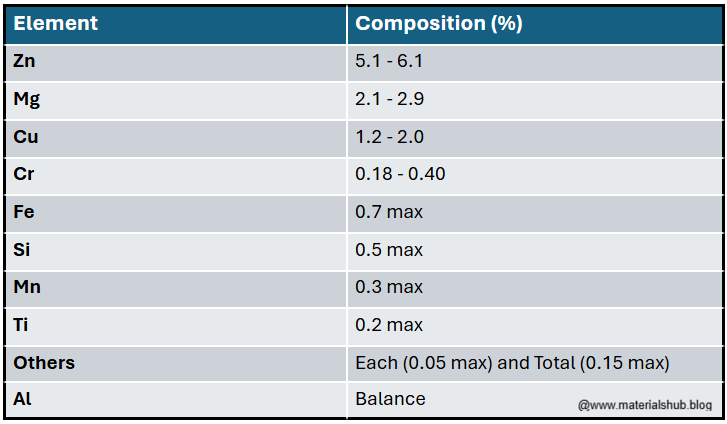
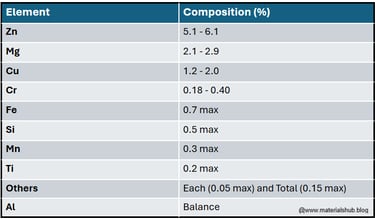
Chemical composition of Aluminum 7075 Alloy.
3. How does Heat Treatment Strengthen 7075 Alloy?
Precipitation hardening is an important heat treatment method that provides strength to the alloys by forming tiny, dispersed particles within the crystal structure of metal, which slows down dislocation movement, making the material stronger and harder. Aluminium 7075 alloy gains its strength through precipitation hardening, which involves the following steps:
a) Solution Treatment: Heating the alloy to dissolve all the alloying elements in aluminium.
b) Quenching: Rapidly cool the alloy to trap these elements, creating a supersaturated solid solution (a metastable state).
c) Aging (Precipitation): Reheat alloy to a lower, intermediate temperature. This allows the formation of fine, uniformly dispersed particles (precipitates), such as MgZn2 in the 7075 alloy that block dislocations, thereby increasing the strength and hardness.
These nanoscale precipitates impede the dislocation motion by dramatically enhancing the mechanical properties such as yield strength, tensile strength, and hardness. This is the reason why the 7075 alloy achieves high strength at low density.
4. What are the Key Properties of Aluminium 7075 Alloy?
a) High Strength-to-Weight Ratio:
Aluminium 7075 alloy, typically aerospace tempers like T6/T651, is known for possessing high tensile and yield strengths in comparison to some mild steels and other aluminium alloys while having low density. The T6/T651 tempers are reported to have a tensile strength of 83 Ksi and a shear strength of 48 Ksi.
b) Demonstrated performance in real aircraft structures:
Through decades of aircraft design practice and materials data handbooks, the 7075 alloy is frequently specified for highly stressed aircraft components and fittings, mainly at places where the engineers require high strength at low weight. Also, 7075 alloy is known for possessing high hardness and fatigue resistance which is excellent for structural parts subjected to cyclic loadings.
c) Adaptability to heat treatments:
The mechanical performance of 7075 alloy can be tailored through different heat treatments (tempers). The T6 temper provides high strength, while the T73 and T76 tempers trade some amount of strength for enhanced resistance to SCC.
d) Good machinability:
Aluminium 7075 alloy can be formed into complex geometries and tight tolerances, which is an important advantage for manufacturing complicated aerospace components such as gears, shafts, and fittings.
While highly valued, the aluminium 7075 alloy has its own limitations. It has a moderate resistance to corrosion compared to other aluminium alloys and is vulnerable to SCC in its high-strength T6 temper. The alloy is also generally considered difficult to weld using traditional methods.
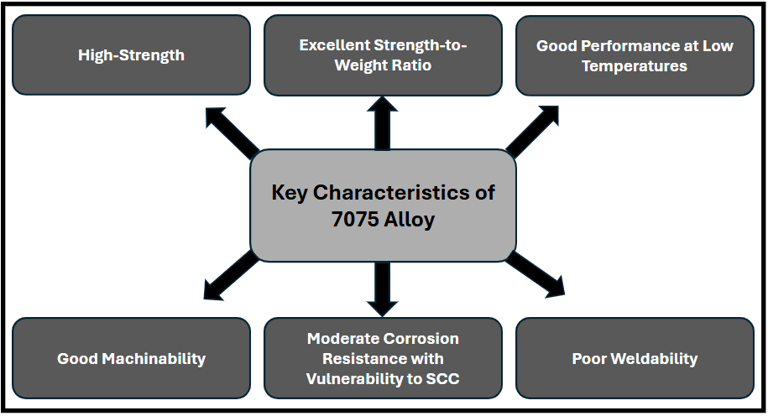
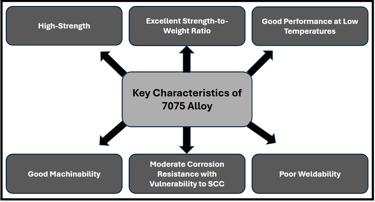
Key characteristics of aluminium 7075 alloy.
5. Where is Aluminium 7075 Alloy Utilized in Aerospace?
Aluminium 7075 alloy is mostly associated with load-bearing aircraft structures and fittings, including:
Wing Structures: Spars, ribs, and skins that need high strength to withstand aerodynamic forces without excessive weight.
Structural fittings: Connectors and hardware that demand reliability under thermal changes and vibration.
Fuselage: Frames, stringers, and keel beams for structural stability and impact resistance.
Highly stressed machine components such as brackets, lugs, and fittings.
Aluminium 7075 alloy, usually in T6/T651 tempers, provides an optimal balance of mechanical properties for important aerospace applications, maintaining structural integrity while minimizing weight. Engineers may pair 7075 with other alloys depending on whether fatigue/fracture toughness or corrosion is the dominant requirement (e.g., 2xxx series for damage tolerance in some skins, or 7xxx variants like 7050/7150 in thick sections). The “most common” answer depends on the aircraft zone and era, but 7075 remains a flagship alloy for high-strength aluminium aerospace design.
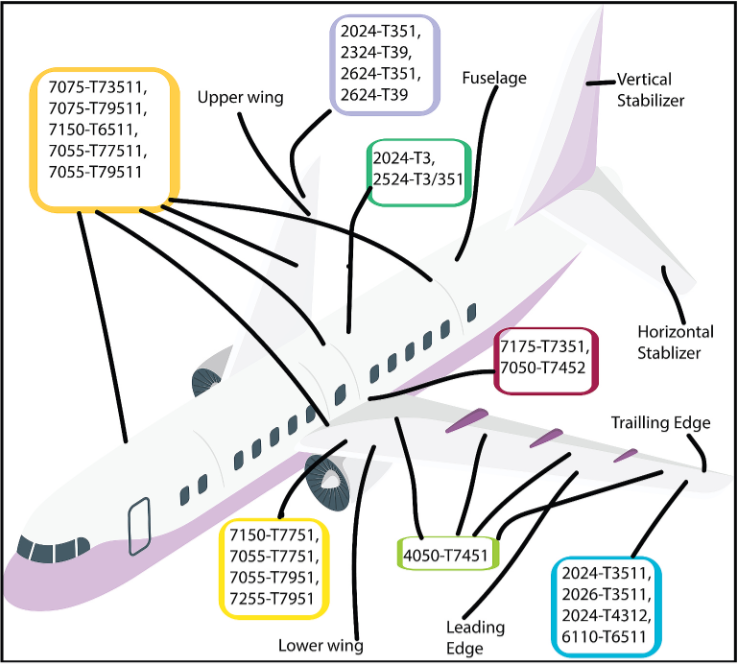
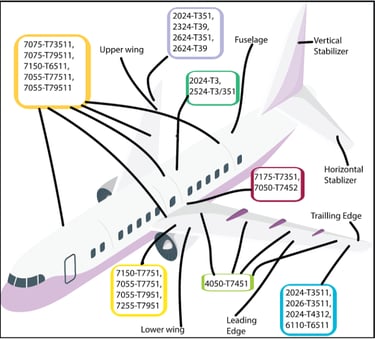
Applications of different aluminium alloys in aircraft structures (ScienceDirect).
6. Why Aluminium 7075 alloy is preferred over Pure Aluminium, Steel, or Titanium?
Steel:
Aluminium alloys like 7075 and 2024 provide strength comparable to steel but at one-third of the density, which makes them an excellent choice for reducing the overall weight of the aircraft.
Aluminium alloys are easily machinable, formable, and suitable for creating complex aerospace components like wing skins, frames, and fuselage panels. Aluminium is even easier and faster to machine and fabricate in comparison to steel, thereby reducing the production costs.
The high conductive nature of aluminium is advantageous for shielding avionics and handling lightning strikes.
Though steel is stronger and preferable for high-temperature applications, the excellent high strength-to-weight ratio performance of aluminium alloys makes it the foundational material for most aircraft structures.
Pure Aluminium:
Aluminium alloys are important for achieving high strength and minimizing weight, which improves the fuel efficiency and increases the payload capacity.
The incorporation of different alloying elements such as zinc, magnesium, or copper greatly increases the strength and hardness of the material that makes them suitable for withstanding high stresses and loads.
Aluminium alloys such as 7075 and 5052 are engineered to resist corrosion from environmental conditions, thereby protecting the structure of aircraft.
While pure aluminium is not suitable for structural use, the addition of various alloying elements provides enhanced mechanical properties to withstand extreme forces and loads.
Titanium:
Aluminium has much lower density than titanium which makes it ideal for reducing the overall mass of the aircraft, thereby improving the fuel efficiency and load capacity.
Aluminium alloys are considered economical for large-scale production as they are cheaper to manufacture and procure.
Titanium is difficult to machine in comparison to aluminium which is easier to machine, form, and weld, thus reducing manufacturing complexity.
It is to be noted that titanium and its alloys are still preferred for high-stress and high-temperature applications including, engine components and landing gear.
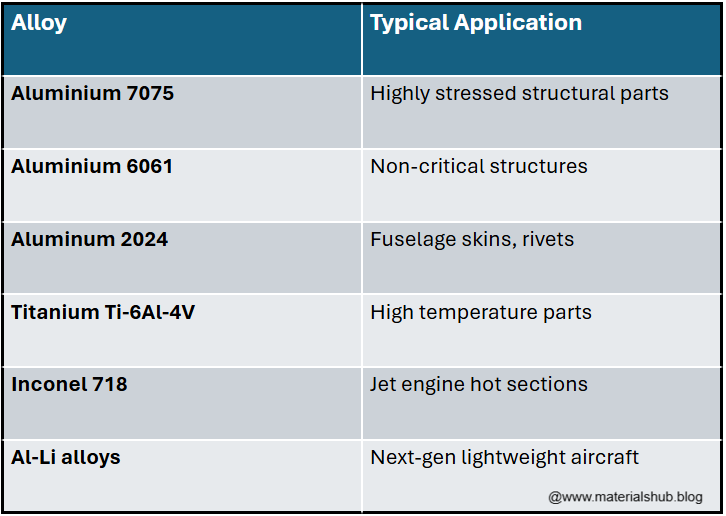
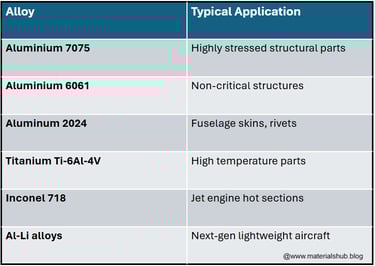
Comparison between 7075 and other important aerospace alloys.
7. What Must Engineers Watch Out for Before Choosing Aluminium Alloy for Aircraft Design?
a) Stress Corrosion Cracking (SCC):
A well-known limitation pertaining to 7xxx aluminium alloys is their vulnerability to Stress Corrosion Cracking (SCC) in some tempers and environments. For this reason, the aerospace industry sometimes prefers overaged tempers such as T73/74 or utilizes protective coatings. These tempers are designed to maximize SCC resistance with some trade-off for tensile strength compared to the T6 temper.
Current research reviews continue to study mechanisms of SCC in aluminium alloys and emphasize the roles of environment, microstructure, and different cracking modes (generally involving combined electrochemical and hydrogen effects depending on conditions).
b) Temperature limits:
Aluminium 7075 alloy is not suitable for high temperature aerospace applications as its high-strength precipitate structure becomes unstable above 100 ℃, leading to severe strength degradation. The alloy is highly susceptible to SCC at elevated temperatures, limiting its utilization to cold-structure components. From literature, it is observed that at 150 ℃, the yield strength of 7075 alloy decreases by around 30%, making it unsuitable for high-stress applications in hot, structural areas of aircraft.
These reasons make aluminium 7075 alloy better for fuselage or wing structures at lower temperatures. Other parts exposed to engine-adjacent temperatures require other different materials like titanium alloys or specialized aerospace steels.
c) Designing-by-zone
The aerospace industry does not rely on any one alloy to build an aircraft; instead, it uses a material ecosystem:
7xxx alloys for applications requiring high strength.
2xxx alloys in zones prioritizing damage tolerance/fatigue behavior.
Titanium alloys for high-stressed and high-temperature applications.
Carbon fiber-reinforced composites for weight reduction and corrosion resistance.
Conclusion
If someone is looking for an answer to the question, "Which is the most commonly used alloy in the aerospace industry?" from a structural-metal viewpoint, Aluminium 7075 alloy (commonly 7075- T6/T651 and other aerospace-related tempers) is one of the most justifiable choices, as it provides a great balance of low weight, high strength, and well-established aerospace qualification.
At the same time, the selection of aerospace material is application-specific and engineers balance the performance of aluminium 7075 alloy with known risks such as SCC, coatings, temper selection, and proper design to confirm reliability.
FAQs
1. Is Aluminium 7075 the strongest aluminium alloy used in the aerospace industry?
Answer: Aluminium 7075 alloy is among the commonly used high-strength alloys, usually tempers like T6/T651, which makes it useful for highly stressed structural components.
2. What are the main disadvantages associated with Aluminium 7075 Alloy?
Answer: The main concern is stress corrosion cracking (SCC) susceptibility in certain environmental conditions and tempering, along with moderate corrosion resistance in comparison to some other aluminium alloys, so protective coatings and correct temper selection matter.
3. Is Aluminium 7075 alloy still widely used in modern aircraft even with the availability of composite materials?
Answer: Even with the utilization of composites, reviews show that aluminium alloys still play an important role in aerospace parts owing to their cost, manufacturability, repairability, and well-established design allowables.
4. Which alloy competes most with 7075 in airframes?
Answer: Historically, 2024 (2xxx series) has been widely utilized in various airframe applications, usually where fatigue/damage tolerance balance is prioritized, while 7xxx alloys are generally favored for maximum strength zones.
References:
[1] Li, S. S., Yue, X., Li, Q. Y., Peng, H. L., Dong, B. X., Liu, T. S., ... & Jiang, Q. C. (2023). Development and applications of aluminum alloys for aerospace industry. Journal of materials research and technology, 27, 944-983. https://doi.org/10.1016/j.jmrt.2023.09.274
[2] Muraca, R. F., & Whittick, J. S. (1972). Materials data handbook: Aluminum alloy 7075 (No. NASA-CR-123773).
[3] Sessler, J., & Weiss, V. (1966). Materials data handbook, aluminum alloy 7075 (No. NASA-CR-80764).
[4] https://www.spacematdb.com/spacemat/manudatasheets/alcoa_alloy_7075.pdf
[5] Loto, C. A. (2017). Stress corrosion cracking: characteristics, mechanisms and experimental study. The International Journal of Advanced Manufacturing Technology, 93(9), 3567-3582. https://doi.org/10.1007/s00170-017-0709-z
[6] Khalid, M. Y., Umer, R., & Khan, K. A. (2023). Review of recent trends and developments in aluminium 7075 alloy and its metal matrix composites (MMCs) for aircraft applications. Results in Engineering, 20, 101372. https://doi.org/10.1016/j.rineng.2023.101372
[7] Yang, Y., Wu, Y., Jin, S., Wang, D., Zhang, S., & Zha, M. (2025). A brief review on stress corrosion cracking of aluminum alloys: mechanisms, prevention, and future perspectives. Journal of Alloys and Compounds, 182430. https://doi.org/10.1016/j.jallcom.2025.182430
[8] Al-Haidary, J. T., Haddad, J. S., Alfaqs, F. A., & Zayadin, F. F. (2021). Susceptibility of Aluminum Alloy 7075 T6 to Stress Corrosion Cracking. SAE International Journal of Materials and Manufacturing, 14(2), 195–202. https://www.jstor.org/stable/27033993
[9] Anderson, K., Weritz, J., & Kaufman, J. G. (2019). 7075 and Alclad 7075: high-strength structural alloy. Properties and Selection of Aluminum Alloys [Internet]. ASM International, 432-8. https://doi.org/10.31399/asm.hb.v02b.a0006737
[10] Rutto, R., Obara, C., & Harrison, S. (2024). Investigation of fatigue cracking in aluminium 7075 alloys and the role of heat treatment. Advances in Materials and Processing Technologies, 10(4), 3700-3723. https://doi.org/10.1080/2374068X.2023.2264576
Contact
© 2026. MaterialsHub. All rights reserved.