Top 5 Best Materials Science Books Every Student and Beginner Must Read
By Mufaddal Shakir
2/20/20263 min read
Materials Science is the backbone of modern technology, from automobiles and aerospace to electronics, energy storage, and biomedical devices. Whether you are a beginner, undergraduate, postgraduate, or an aspiring researcher, having the right textbooks can make a huge difference in building strong fundamentals.
In this article, we list the Top 5 Best Materials Science Books that are globally recommended for their clarity, depth, and long-term value. These books cover core concepts, structure–property relationships, processing, and real-world applications, making them ideal for long-term learning.
These books are not just for exams, but they help you think like a materials scientist.
Why Choosing the Right Materials Science Book Matters?
Materials Science is an interdisciplinary subject by nature as it combines physics, chemistry, and engineering. A good book should:
Explain concepts clearly and logically
Use diagrams and real-world examples
Build intuition about structure–property–processing relationships
Serve as a reference for exams, interviews, and research
The following books excel in all these aspects.
1. Materials Science and Engineering: An Introduction (10th Edition) – William D. Callister Jr. & David Rethwisch
Best for: Beginners, Undergraduates, Core Fundamentals, Long-term reference
Difficulty Level: Introductory to Intermediate
Why is this book a classic?
This book is often known as the Bible of Materials Science. It is extensively used as a primary textbook in universities across the world and is ideal for anyone starting their journey in materials science and engineering.
Key topics covered:
Atomic structure and bonding
Structure of crystalline solids
Mechanical, thermal, electrical, magnetic, optical properties and deformation
Phase diagrams and transformations
Material failure mechanisms
Structure, properties, and applications of metals, ceramics, polymers, and composites
Environmental and societal issues in materials science and engineering
Why this book is highly recommended?
Extremely student-friendly
Excellent illustrations and graphs
Strong focus on engineering applications
Good balance between theory and practice
If you are going to read only one materials science book as a beginner, then this should be it.
2. Materials Science and Engineering (6th Edition) – V. Raghavan
Best for: Indian Curriculum, Competitive exams
Level: Undergraduate to Postgraduate
Why this book stands out?
V. Raghavan’s books are known for their clarity and depth, especially popular among the students who are preparing for exams such as GATE, ESE, JAM, and PSU.
Key topics covered:
Crystal defects and diffusion
Phase equilibria and kinetics
Mechanical behaviour of materials
Diffusion and phase transformations
Why you should read it?
Written in a systematic, clear, and exam-oriented manner
Excellent for problem-solving and theory building
Good for learning core fundamentals
This book is highly recommended for Indian students.
3. The Science and Engineering of Materials (7th Edition) – Donald R. Askeland & Wendelin J. Wright
Best for: Conceptual clarity, Applications-based learning
Level: Beginner to Intermediate
What makes this book unique?
This book focuses heavily on connecting theory with real-world engineering problems.
Key topics covered:
Structure–property relationships
Mechanical, thermal, and electrical properties
Materials selection for engineering applications
Failure mechanisms and design considerations
Why should you read it?
Easy understanding with real engineering examples
Strong emphasis on materials selection
Great book for automobile and mechanical engineering students
4. Introduction to Materials Science for Engineers (9th Edition) – James F. Shackelford
Best for: Quick reference, Concept reinforcement
Level: Beginner-friendly
Why is this book useful?
This textbook is concise, well-structured, and perfect for quick revision and concept building.
Key topics covered:
Crystalline structures and atomic bonding
Thermal and mechanical behaviour of materials
Electrical, magnetic, and optical properties
Failure analysis and prevention
Crystal defects and imperfections
Polymers, ceramics, and composites
Why should you read it?
Easy to understand and very well-organized
Ideal as a supplementary textbook
Great for interview preparation and exam revision
5. Physical Metallurgy Principles (3rd Edition) – Robert E. Reed-Hill and Reza Abbaschian
Best for: Advanced metallurgy, Research-oriented learning
Level: Intermediate to Advanced
Why this book is important?
If you want to gain in-depth knowledge into metallurgy and phase transformations, this book is a gold standard.
Key topics covered:
Thermodynamics of materials
Diffusion and phase transformations
Strengthening mechanisms
Heat treatment methods of metals
Why should you read it?
Research-oriented approach
Strong focus on fundamental physical principles
Excellent for Master’s and PhD students
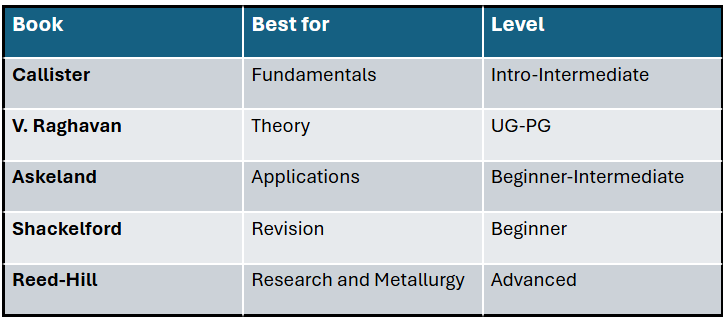
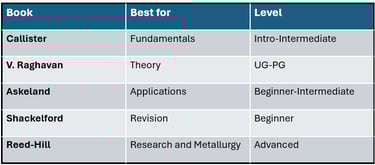
Comparison between the books.
Final Thoughts
A strong foundation in Materials Science opens doors to careers in various fields including automobile, aerospace, semiconductors, energy, biomaterials, and research labs. Although there are other great books, these five books collectively cover theory, applications, and real-world relevance, making them a must-have for any serious learner.
If you are passionate about materials science and engineering, these books will serve you throughout your academic and professional journey.
FAQs – Materials Science Books
Q1. Which is the best materials science book for beginners?
Answer: Callister’s Materials Science and Engineering is the best starting point.
Q2. Which book is best for GATE or JAM preparation?
Answer: V. Raghavan is highly recommended.
Q3. Are these books useful for research?
Answer: Yes. Reed-Hill and Callister are widely cited in research.
Q4. Can automobile engineering students use these books?
Answer: Absolutely. These books are highly relevant for automotive materials and manufacturing.
Q5. Do I need to read all five books?
Answer: No. Start with one or two, depending on your level, and expand as your understanding grows.
Affiliate Disclaimer:
Some links in this article may be affiliate links. This means we may earn a small commission at no extra cost to you. This helps support our website and allows us to continue creating high-quality educational content.
Contact
© 2026. MaterialsHub. All rights reserved.